
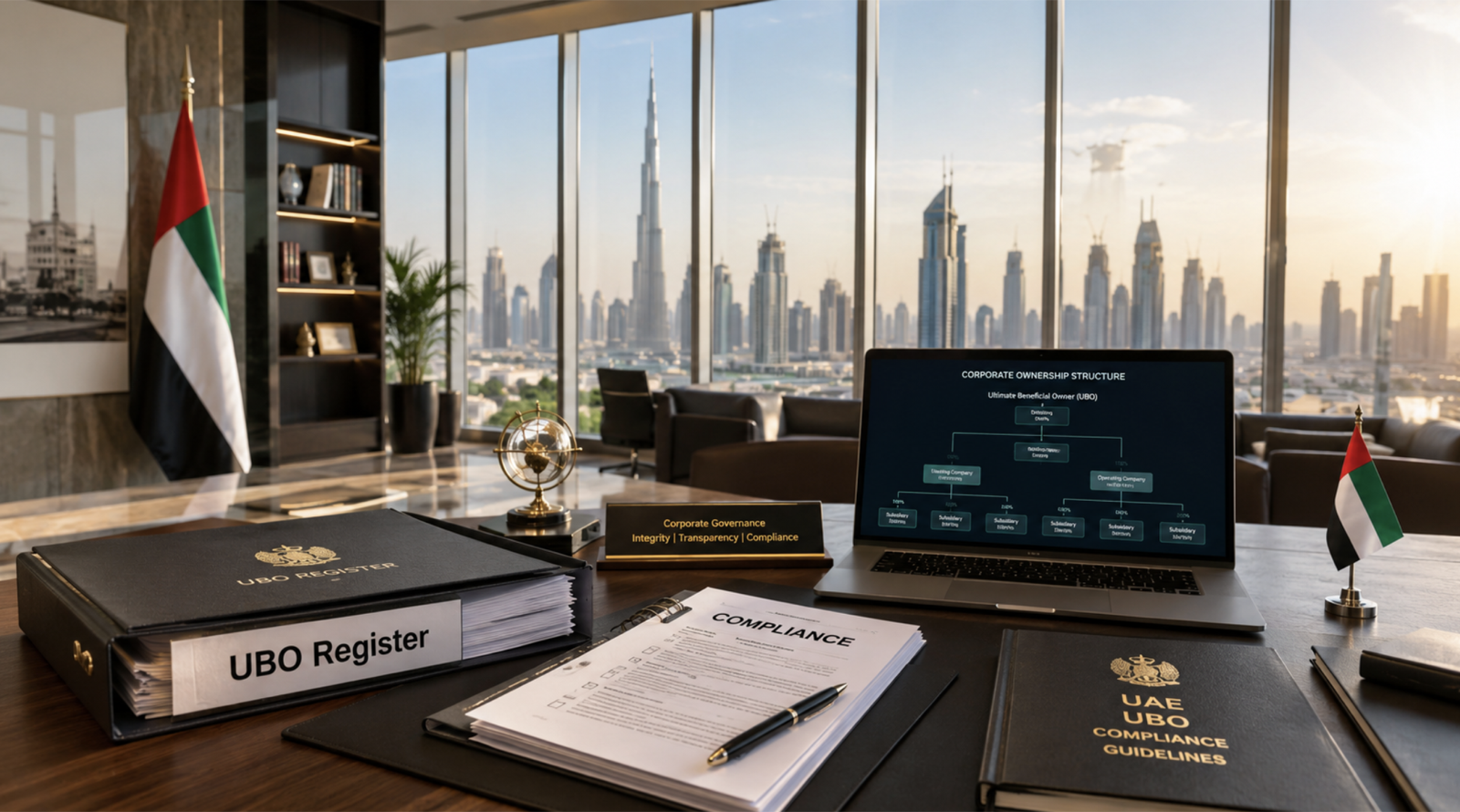
Every UAE-licensed company, including most free zone entities, is required to identify, maintain, and declare its Ultimate Beneficial Owner under the current UAE UBO regulations. In practice, however, many businesses operate with registers that are incomplete, outdated, or inconsistent across their corporate records. The obligation to maintain a UBO declaration in the UAE sits within the country’s broader anti-money-laundering and counter-terrorism-financing framework established under Federal Decree-Law No. 20 of 2018, and non-compliance may result in administrative fines and licensing consequences under the current framework.
Updates introduced through Cabinet Decision No. (109) of 2023 and Cabinet Decision No. (132) of 2023 have clarified the current compliance position for UAE entities. This guide outlines what companies commonly need to understand in practice, including ownership and control thresholds, registers and declarations, notification obligations, recordkeeping expectations, and the most common compliance gaps that may arise during regulatory, banking, or investor review processes.
PHASE 1: Understanding What a UBO Is
What Is a UBO Under UAE Rules?
An Ultimate Beneficial Owner (UBO) is a natural person who ultimately owns or controls a legal entity. This control may arise through ownership interests, voting rights, or other forms of effective control over the entity. Understanding what is UBO in UAE commonly begins with identifying the natural person behind the ownership structure rather than stopping at the first corporate shareholder level.
The concept forms part of the UAE’s broader anti-money-laundering and counter-terrorism-financing framework under Federal Decree-Law No. 20 of 2018 on AML/CFT. It also reflects international transparency standards associated with Financial Action Task Force (FATF) recommendations.
The current framework governing UBO in UAE is set out under Cabinet Decision No. (109) of 2023 on Regulating the Beneficial Owner Procedures, together with the associated penalty framework under Cabinet Decision No. (132) of 2023. Companies relying on older records or historical filings may therefore need to reassess whether their current position remains aligned with the latest UAE UBO regulations issued by the Ministry of Economy and the relevant licensing authority.
Who Qualifies as a UBO: Ownership and Control Thresholds
Determining the ultimate beneficial owner UAE requires applying a structured ownership and control test. The primary benchmark is the 25% threshold, but it applies across several forms of ownership and control.
An individual is generally considered a UBO if they:
- Own 25% or more of the company’s share capital, directly or indirectly
- Hold 25% or more of voting rights
- Have the right to appoint or dismiss the majority of directors or managers
The regulations also recognize “other means of control” for arrangements where formal ownership does not fully reflect effective influence, including certain contractual or nominee arrangements.
Where no individual meets these thresholds, and no other controlling person can be identified, the individual serving in a Senior Management role is generally treated as the UBO.
Many business owners assume their structure is straightforward. However, where holding companies, foundations, trusts, or layered ownership structures are involved, the analysis generally needs to trace through the ownership chain until a natural person is identified. Stopping at the first corporate shareholder level may not satisfy UBO rules for companies UAE during regulatory review.
PHASE 2: Determining If Your Company Must Comply
UAE UBO Regulations: Who Must Comply
The scope of UAE UBO regulations applies to most entities licensed and registered in the UAE, including mainland companies and commercial free zone entities.
Financial free zones operate under their own substantively aligned frameworks administered separately from the federal regime. As a result, while the underlying principles of UBO compliance UAE remain broadly consistent, filing procedures and supervisory authorities may differ depending on the jurisdiction.
Wholly government-owned entities and entities licensed within financial free zones generally operate under separate frameworks. For most private-sector businesses, however, the obligation remains with the licensed entity itself rather than solely with advisors, directors, or external service providers.
In practice, company compliance UBO UAE obligations are generally administered through the relevant licensing authority, and businesses are expected to maintain documentation aligned with the requirements applicable to their jurisdiction.
PHASE 3: What You Must Prepare and Maintain
Registers Every UAE Company Must Maintain
A core part of UBO compliance requirements UAE is maintaining accurate internal registers. These records form the basis of regulatory filings, ownership verification, and ongoing company compliance UBO UAE obligations.
The Register of Beneficial Owners is generally expected to include:
- Full name and identification details of each UBO
- Nationality and personal information
- The basis of ownership or control
- Dates of acquisition and cessation of UBO status
Companies are also generally required to maintain a Register of Partners or Shareholders in parallel with the UBO register. These records should remain reconciled, as inconsistencies may create exposure during regulatory, banking, or due diligence reviews.
Where applicable, entities must also maintain a Register of Nominee Directors or Board Members for arrangements involving nominee structures.
Under the current framework, registers and supporting records must generally be retained for at least five years following dissolution, liquidation, or de-registration. Responsibility for maintaining accurate records rests with the licensed entity itself, and businesses are commonly expected to review and update these registers as part of their ongoing compliance process.
UBO Declaration in the UAE: What to File and When
to the Registrar, typically the relevant licensing authority, as part of incorporation and ongoing licensing compliance.
For new entities, the Register of Beneficial Owners must generally be submitted within 60 days of registration. While submission procedures may vary between jurisdictions, the obligation forms part of the broader UBO requirements UAE framework.
Each UBO entry commonly includes:
- Full legal name
- Nationality
- Date and place of birth
- Residential address
- Identification number, such as Emirates ID or passport details
- Basis of ownership or control
- Date the individual became a UBO
The framework also requires a natural person resident in the UAE to be authorized to disclose the information on behalf of the entity.
For businesses assessing how to register ultimate beneficial owner UAE obligations, the filing process generally needs to align with the procedures of the relevant licensing authority.
PHASE 4: Keeping Your UBO Status Compliant
Ongoing Updates and Notification Obligations
Ongoing Updates and Notification Obligations
UBO obligations do not end with the initial filing. Under the current framework, changes to UBO information generally must be notified to the Registrar within 15 days of the change.
This commonly includes:
- Share transfers or changes in ownership percentages
- Capital restructurings
- Changes in nominee arrangements
- Changes in directors or management with appointment or dismissal authority
- Reorganizations affecting the ownership chain
In practice, even a partial ownership change may alter the outcome of the 25% control analysis and require reassessment of the entity’s UBO position.
As part of UBO compliance UAE, businesses commonly benefit from integrating register reviews into regular compliance cycles rather than treating them as year-end exercises. Maintaining accurate records through ongoing reconciliation and accounting and bookkeeping services may help support an audit-ready compliance position and contribute to long-term operational stability.
Penalties for UBO Non-Compliance
Failure to meet UBO compliance requirements UAE may result in administrative penalties under Cabinet Decision No. (132) of 2023. The current framework sets out penalty ranges that may extend into the hundreds of thousands of dirhams depending on the category and frequency of the violation. Companies are generally directed to the Ministry of Economy and the relevant licensing authority for the current schedule and enforcement position.
Potential consequences may include:
- Administrative fines set out under Cabinet Decision No. (132) of 2023
- Restrictions on the powers of directors, board members, or owners
- Suspension of commercial licenses
- Closure of commercial establishments under Article 3(1) of Cabinet Decision No. (132) of 2023
In practice, company compliance UBO UAE issues may also surface during bank onboarding, facility reviews, audit procedures, or investor due diligence processes. Incomplete or inconsistent records may therefore create broader governance, regulatory, and operational considerations beyond the immediate filing obligation, particularly where businesses are assessing wider corporate tax services in Dubai and compliance readiness.
PHASE 5: Avoiding Common Risks
Common UBO Compliance Mistakes to Avoid
Many companies assume their existing records already satisfy UBO compliance UAE obligations. In practice, however, gaps commonly arise where ownership analysis, documentation, and ongoing updates are not reviewed consistently.
Common issues include:
- Treating the corporate shareholder as the UBO without tracing ownership through to the underlying natural person
- Defaulting to Senior Management without first applying the ownership, voting, and control tests
- Failing to notify changes within the 15-day window following a share transfer, restructuring, or governance change
- Maintaining the Register of Beneficial Owners as a static document instead of reconciling it against shareholder records after each change
- Relying on outdated 2020 or 2021 references instead of the current 2023 framework
- Inconsistent identification of UBOs across banking, licensing authority, and FTA-related filings
Many companies assume their structure is straightforward, but without a documented and consistently applied control test, the position may not hold up under scrutiny. In practice, company compliance UBO UAE obligations commonly depend less on the complexity of the structure itself and more on whether ownership and control assessments are maintained accurately over time.
PHASE 6: Structuring for Long-Term Compliance
How to Build UBO Compliance Into Your Corporate Structure
A more effective approach to UBO compliance requirements UAE is to address ownership and control analysis at the point of incorporation rather than retrospectively.
Where layered structures are involved, businesses are commonly expected to map the full ownership chain through holding companies, foundations, trusts, or related entities to ensure the ultimate beneficial owner UAE is identified correctly and supported by appropriate records. This process is often integrated into broader company setup in Dubai and entity structuring considerations.
In practice, companies commonly benefit from:
- Centralizing UBO documentation alongside shareholder agreements, share certificates, and governance records
- Assigning a single accountable owner for maintaining the UBO file internally
- Aligning UBO reviews with Corporate Tax filings, banking renewals, and broader audit requirements in the UAE
- Maintaining ongoing reconciliation and periodic compliance reviews across internal records
Businesses that integrate compliance into the corporate structure from the beginning are generally better positioned to maintain audit-ready records and support long-term operational stability across broader regulatory obligations.
FAQ
What is the Ultimate Beneficial Owner under UAE law?
The Ultimate Beneficial Owner (UBO) is the natural person who ultimately owns or controls a company through ownership, voting rights, or other forms of effective control. Under the current framework, this is commonly assessed using the 25% ownership or control threshold under Cabinet Decision No. (109) of 2023.
Who qualifies as a UBO under the 25% ownership and control test?
An individual generally qualifies if they hold 25% or more of shares, voting rights, or authority over key governance decisions such as appointing or removing directors. Where no individual meets these thresholds, the company must assess other forms of control before relying on the Senior Management fallback.
Is a UBO declaration mandatory for free zone companies in the UAE?
Yes. Most free zone entities are generally required to submit a UBO declaration UAE through the relevant licensing authority, although filing procedures may differ between jurisdictions.
How quickly must a UAE company notify changes to its Register of Beneficial Owners?
Changes to ownership, control, or identification details generally must be reported within 15 days as part of ongoing UBO requirements UAE obligations.
What happens if a UAE company fails to file or update its UBO information?
Non-compliance may result in administrative fines under Cabinet Decision No. (132) of 2023, together with potential licensing restrictions and broader compliance considerations during banking, audit, or due diligence reviews.
What if no individual meets the 25% threshold — who is treated as the UBO?
Where no individual qualifies under the ownership or control tests, a Senior Management official is generally treated as the UBO to ensure accountability remains assigned to a natural person.
Closing
Maintaining accurate ultimate beneficial owner UAE records commonly forms part of a broader compliance and governance framework rather than a standalone filing obligation. Businesses that integrate compliance into the corporate structure from the beginning are generally better positioned to support regulatory transparency, banking reviews, audit readiness, and long-term operational stability.
UBO accuracy also commonly intersects with broader corporate tax services in Dubai and ongoing corporate governance considerations, particularly where ownership structures, related-party arrangements, or regulatory reporting obligations evolve over time.
At MP Elites Consulting, we support businesses assessing ownership structures, compliance documentation, and ongoing regulatory alignment across the UAE. If you would like to review your current position in more detail, Request a Strategic Assessment.